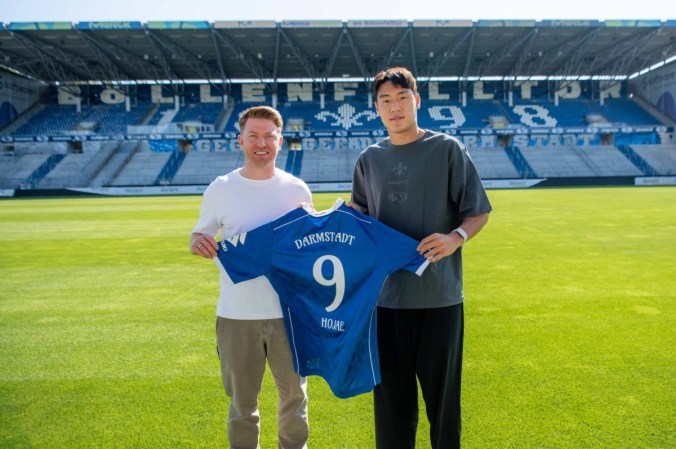
Nach dem Schotten Fraser Hornby und dem Schweden Isac Lidberg soll fortan der Südkoreaner Lee Ho-jae das Toreschießen beim SV Darmstadt 98 übernehmen. Was die Spatzen schon länger von den Dächern pfiffen ist nun vollzogen. Die Lilien verpflichteten den 25-Jährigen von den Pohang Steelers. Die Fußstapfen, in die er treten muss sind sehr groß, die Erwartungshaltung der SVD-Fans gleichfalls. Was ist von dem Angreifer zu halten, der mit Sicherheit in die Kategorie fällt, die Paul Fernie (Geschäftsführer Sport), so gerne als kreativen Transfer bezeichnet? Ich wendete mich an den südkoreanischen Fußballjournalisten Han June, um ihn über seine persönlichen Ansichten zu Lee Ho-jae zu befragen. Am Ende des Interviews habe ich die wichtigsten Aussagen ins Deutsche übersetzt.(Bildquelle: www.sv98.de )
Paik Seung-ho, Ji Dong-won and Cha Bum-kun are three players from South Korea who have played for Darmstadt 98 so far. Now Lee Ho-jae is joining that list. Was his move to Europe an obvious choice for you?
Lee Ho-jae has consistently expressed a strong desire to move to Europe. Rather than accepting a transfer elsewhere in Asia on more lucrative salary terms, he was prepared to wait for the right opportunity in European football.
He is the son of Lee Ki-hyung, who was regarded as one of South Korea’s leading left-backs during his playing career. Lee Ki-hyung represented the Korean national team in the 1990s and remained one of the K League’s best left-backs into the 2000s. He was particularly renowned for his powerful long-range shooting and is now working as a football coach.
Lee Ho-jae is considered an ambitious player who is highly motivated to build a successful career. Like his father, he possesses a very powerful shot. However, with his greater height and significantly stronger physical profile, he is expected to forge an even more successful career as a centre-forward. Given his physical attributes, pursuing an opportunity in European football was a natural and logical step for him. I believe he should be capable of coping with the robust nature of the 2. Bundesliga.
What reputation has Lee built up in K League 1?
As is the case in many Asian leagues, the K League’s top-scorer race is often dominated by foreign forwards, particularly players from Europe and South America. Against that backdrop, Lee has earned a strong reputation as one of the few Korean strikers capable of mounting a serious challenge for the K League 1 Golden Boot. His scoring record has occasionally fluctuated because of injuries and other fitness-related issues, but with consistent service and a full season of regular football, he is certainly capable of competing for the top-scorer award.
Darmstadt have had to let their two top strikes, Isac Lidberg (17 goals) and Fraser Hornby (11 goals), leave. Lee must now follow in their footsteps. The supporters‘ expectations are correspondingly high. Do you know if Lee speaks English, and do you think he‘ll be able to settle in quickly to a new country, a new team and a new league?
Lee’s English is excellent. During the period when his father, Lee Ki-hyung, was playing for Auckland City in New Zealand, Lee Ho-jae spent part of his youth career there. He developed at Onehunga Sports and also spent time in the Wellington Phoenix youth system. As a result of growing up and playing football in New Zealand, he is highly proficient in English. That should help him considerably when it comes to adapting to a new country, dressing room and footballing environment.
Is Lee a playmaking striker up front or a clinical finisher, who mainly looks for his chances in and around the penalty box?
At Asian level, he has shown that he can compete physically with centre-backs, protect the ball, bring teammates into play and perform the responsibilities of a genuine No. 9. His ball retention and passing are also relatively sound, meaning he can sometimes operate more like a “nine-and-a-half,” dropping into deeper areas and contributing to combination play in a manner broadly comparable to the role associated with Karim Benzema.
However, his first touch is not always exceptionally refined, and the quality of his control and finishing can fluctuate from one match to another. He has sufficient tactical intelligence and versatility to perform several different functions, but expectations should remain realistic. He should not be expected to arrive as a fully developed, elite-level striker. The hope should be that he continues to learn, improve and refine his game in Europe.
Lee‘s build and hight are simolar to Bayern‘s Kim Min-jae. That should mean he‘s strong in the air?
At 193 centimetres, Lee is strong in aerial duels and is capable of operating as a target man. Whereas earlier in his career, his aerial-duel success rate was somewhat disappointing. However, he has improved in this area season by season. He is not as dominant in the air as Kim Min-jae, but he has gradually developed into a much more competitive aerial presence.
Where do you see room for improvement in his game?
The main area he needs to address is consistency. He must reduce the fluctuations in his overall performance level. His lack of pace is also one of his limitations, as he is not an especially quick forward. He needs to improve his speed endurance and make quicker decisions, particularly regarding the timing of his runs when attempting to break the opposition’s offside line. And he will need to learn and develop these aspects of his game in Germany. Significant progress in these areas will be important if he is to establish himself as a genuine candidate for the South Korean national team.
You mention the national team. Do you think Lee could become a serious contender for the national team one day?
South Korea currently have Oh Hyeon-gyu of Beşiktaş and Cho Gue-sung of Midtjylland, both of whom are clearly ahead of Lee in the competition for the traditional No. 9 role. Lee has previously been called up to the national team and assessed by the coaching staff, but he did not demonstrate a level of performance superior to those players. Nevertheless, he may still have an opportunity if he develops significantly in Germany. In addition to the players already mentioned, Lee Young-jun of Grasshopper and Oh Se-hun, who is currently playing in the J League, are also among his direct competitors. Lee is certainly part of the wider group of tall centre-forwards who can offer target play, link-up play, headed goals and penalty-box finishing. However, at present, he is probably the lowest-ranked option among those candidates. The decisive factor will be the extent to which he can develop and improve during his time in Germany.
Miltary service is a compulsory in Korea. Has Lee already completed it, or does he still need to do so?
Lee underwent surgery in August 2024 after suffering an injury to his left foot and was sidelined for an extended period.
Because of the medical history associated with that injury, he was granted an exemption from compulsory military service. Therefore, he will not be required to complete military service in the future.
Han June, thank you very much for sharing your thoughts about Lee.
Die Zusammenfassung der wichtigsten Aussagen aus dem Interview:
- Es war schon lange der Wunsch von Lee nach Europa zu wechseln. Ein Wechsel in eine finanziell lukrativere asiatische Liga kam nicht infrage. Er wartete deshalb auf die richtige Möglichkeit nach Europa zu gehen. Lees Vater war in den 1990ern Nationalspieler. Er war Linksverteidiger und bekannt für seine kraftvollen Weitschüsse. Er arbeitet heute als Trainer.
- Lee Ho-jae ist ein sehr ambitionierter Spieler und sehr motiviert eine erfolgreiche Karriere zu durchlaufen. Wie sein Vater so hat auch Lee einen starken Schuss. Da er aber größer und physisch stärker ist, lag eine Karriere als Stürmer näher. Aufgrund seiner körperlichen Voraussetzungen lag der Schritt in den europäischen Fußball nahe. Er sollte deshalb in der Lage sein, sich in der robusten 2. Bundesliga zu behaupten.
- Die Top-Scorer in der K League sind zumeist Europäer und Südamerikaner. Lee war einer der wenigen Koreaner, die ernsthaft um die Torjägerkanone konkurrierten. Aufgrund von gelegentlichen Verletzungen oder fitnessbezogenen Themen war er bislang jedoch nicht konstant genug. Wenn er jedoch fit blieb und gut ins Spiel einbezogen wurde, dann war er ein Anwärter.
- Der Vater von Lee spielte während seiner Karriere in Neuseeland. Lee spricht deshalb exzellent Englisch, spielte auch in seiner Jugend bei neuseeländischen Klubs und sollte deshalb in der Lage sein, sich rasch an ein neues Umfeld zu gewöhnen.
- Lee weiß den Ball zu behaupten und seine Mitspieler einzusetzen. Er erfüllt auch die Aufgaben einer Nummer 9. Seine Ballbehandlung und sein Passspiel sind solide, sodass er auch als sich zurückziehende „Neuneinhalb“ agieren kann.
- Sein erster Ballkontakt ist manchmal nicht besonders sauber. Auch können seine Ballkontrolle und sein Abschluss von Spiel zu Spiel schwanken. Lee hat die taktische Intelligenz und Vielseitigkeit, um verschiedene Rollen im Spiel auszuüben. Dennoch muss man realistisch bleiben. Lee kommt nicht als voll ausgebildeter Eliteangreifer nach Darmstadt. Es geht für ihn darum hinzuzulernen und sein Spiel weiter zu verbessern.
- Lee ist 1,93m groß und hat sein Kopfballspiel sehr verbessert. Er kann als Zielspieler fungieren.
- Verbessern sollte er seine Konstanz. In seiner Schnelligkeit ist er ebenfalls limitiert. Er sollte auch schneller in seiner Entscheidungsfindung werden und seine Läufe besser timen, wenn es etwa um Abseitsentscheidungen geht.
- Im Nationalteam stehen einige Angreifer vor ihm, er durfte sich aber bereits bei der Nationalmannschaft präsentieren (drei Länderspiele während der Ostasienmeisterschaften 2025, allerdings ohne die Topspieler). Er ist also Teil des erweiterten Kreises, aber dennoch hinten dran. Es wird also darauf ankommen, sich in Deutschland durchzusetzen und zu verbessern.
- Lee hatte 2024 eine Operation am linken Fuß, die ihn länger außer Gefecht gesetzt hat. Aufgrund dieser Verletzung wurde ihm der Militärdienst erlassen. Er muss ihn also nicht mehr ableisten, wie es in Südkorea sonst üblich wäre.
Hier geht es zu weiteren Insider-Interviews über die bisherigen Sommertransfers:
| Noah Weißhaupt Offensiver Flügelspieler | Insider-Gespräch mit Tim vom Millernton |
| Lars Kehl Offensiver Mittelfeldspieler | Insider-Gespräch mit Benjamin von der Neuen Osnabrücker Zeitung |
| Nicolas Verkooijen Offensiver Mittelfeldspieler | Insider-Gespräch mit Daniel, Experte für niederländischen Fußball, u.a. Oranjefussball und Rasenfunk |
| Yannik Lührs Innenverteidiger | Insider-Gespräch mit Chris von der Rhein-Neckar-Zeitung |
| Ibrahim El Kadiri Offensiver Flügelspieler | Insider-Gespräch mit Daniel, Experte für niederländischen Fußball, u.a. Oranjefussball und Rasenfunk |
| Lance Duijvestijn Offensiver Mittelfeldspieler | Insider-Gespräch mit Owen, Experte für den niederländischen Fußball bei Transfermarkt |
| Florian Kleinhansl Außenverteidiger, Schienenspieler | Insider-Gespräch mit Florian, Sportjournalist bei dpa und kicker |
| Christoph Lannert Außenverteidiger, Schienenspieler | Insider-Gespräch mit Eva-Lotta, Arminia-Supporterin und Podcasterin, u.a. im Rasenfunk |
| Carlo Sickinger Sechser, Verteidiger | Insider-Gespräch mit Jonas, Fan der SV Elversberg |


Pingback: Insider im Gespräch über … Milan Smit (#36) | Kickschuh.Blog
Pingback: Insider im Gespräch über … William Mikelbrencis (#25) | Kickschuh.Blog